SIforce Explained: 7 Things Salesforce Teams Need to Know Now
Event On 26 October 2026
Salesforce CEO Marc Benioff announced on October 9, 2026, that AIforce had been renamed SIforce, introducing a new name for the company’s agentic integration layer. The announcement followed a shift in US government terminology from “Artificial Intelligence” (AI) to “Super Intelligence” (SI) in certain official communications. However, Salesforce has not publicly confirmed whether the name change brings any changes to the technology, functionality, or availability of the product.
The announcement marks the latest stage in the evolution of Salesforce’s approach to connecting its platform with AI-powered interfaces.
SI stands for Super Intelligence; SIforce is Salesforce's agentic integration layer, not a partner type.
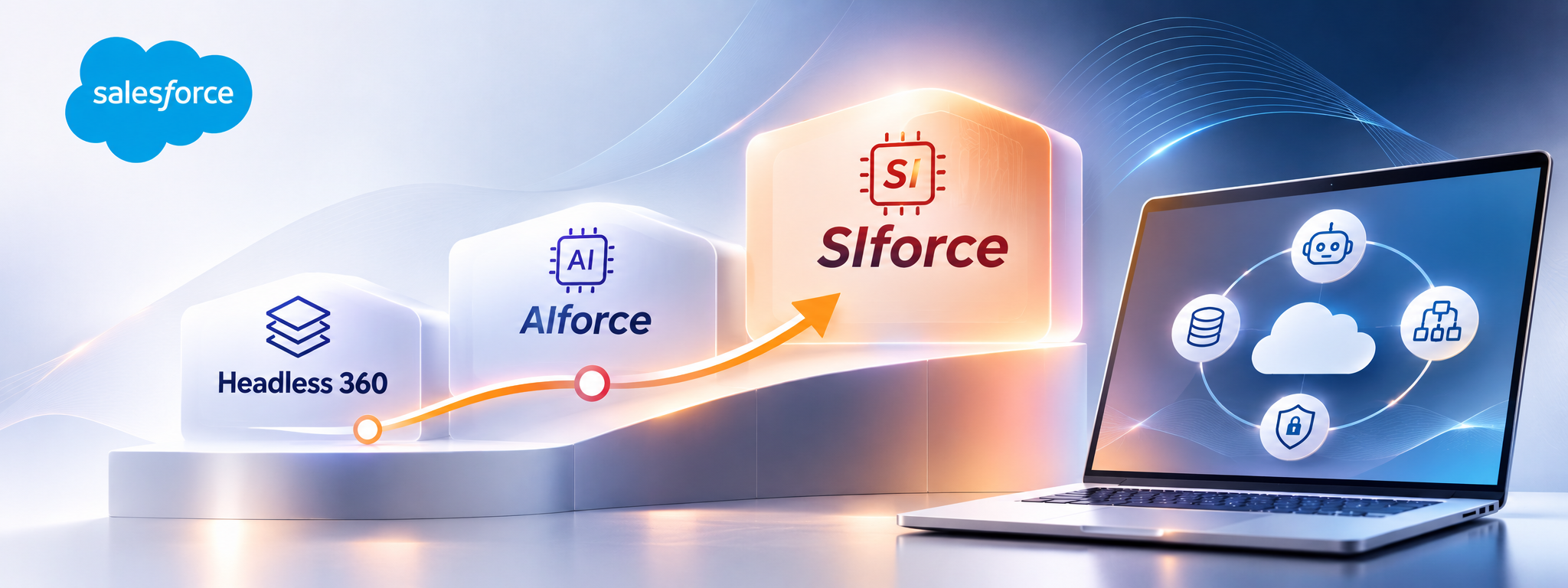
From Headless 360 to AIforce and SIforce
The announcement marks the latest change in the naming of Salesforce’s agentic integration initiative.
According to Salesforce Ben, the initiative was first introduced as Headless 360 at TrailblazerDX in April 2026. Salesforce subsequently announced AIforce at Dreamforce on September 16, describing it as a layer that brings Salesforce data, workflows, business logic, security and governance into different AI interfaces.
The product’s naming history is as follows:
| Date | Name | Development |
|---|---|---|
| April 2026 | Headless 360 | Initially introduced at TrailblazerDX |
| September 16, 2026 | Alforce | Announced at Dreamforce as an agentic integration layer |
| October 9, 2026 | SIforce | Renaming announced by Marc Benioff on X |
The sequence is SIforce (formerly AIforce and Headless 360).
Salesforce’s official September announcement described AIforce as a way for employees and AI agents to access Salesforce capabilities through interfaces such as Claude and Slack, rather than relying exclusively on the traditional Salesforce interface.
However, Salesforce Ben reported on October 12 that it had not identified a separate official Salesforce announcement confirming the rename’s technical implications. The company’s September product announcement continues to use the AIforce name.
US Executive Order Brings Super Intelligence Terminology Into Focus
The rebranding follows an executive order signed by US President Donald Trump on September 29, 2026, titled Inaugurating the Era of Super Intelligence.
According to the White House’s accompanying fact sheet, the order directs federal departments and agencies to use “Super Intelligence” and “SI” instead of “Artificial Intelligence” and “AI” in specified official communications and documents.
The order applies to the US executive branch and does not, by itself, require private companies to rename their products.
Nevertheless, the terminology has become a subject of discussion across the technology sector. Business Insider reported that several technology leaders have adopted the language in public communications, while TheStreet examined the potential business and political context surrounding the shift.
Benioff’s announcement followed this broader development. However, Salesforce has not fully detailed its internal rationale for the rebranding in the reporting reviewed for this article.
What SIforce Means for Salesforce’s Agentic Enterprise Strategy
Salesforce’s September announcement positioned AIforce as an integration layer within its broader Agentic Enterprise architecture.
The stated objective is to make Salesforce’s business context and capabilities available across different working environments, allowing users and AI agents to retrieve information, update records and initiate workflows through supported interfaces.
The architecture described in Salesforce’s original announcement includes:
Data 360
Brings together enterprise data, metadata and context.
Customer 360
Provides business applications, processes, permissions and actions.
Agentforce
Supports the development and deployment of AI agents.
Alforce
Connects these capabilities with external AI interfaces and working environments.
These descriptions reflect Salesforce’s published AIforce architecture. The available reporting does not establish whether the SIforce rename changes this architecture or introduces additional capabilities.
SIforce and Agentforce: Understanding the Distinction
SIforce and Agentforce refer to different roles within Salesforce’s announced agentic architecture.
Agentforce focuses on building and deploying AI agents that can support business tasks. AIforce, as described in Salesforce’s September announcement, provides a way to make Salesforce capabilities accessible through different AI interfaces.
The distinction is relevant for organizations evaluating how to connect AI-assisted experiences with their CRM data, business processes and security controls.
Until Salesforce publishes further documentation under the SIforce name, businesses should refer to the official AIforce announcement for the previously documented capabilities and confirm current product details with Salesforce before making implementation decisions.
What Salesforce Customers Should Consider Next
For Salesforce administrators, architects and business leaders, the immediate priority is to monitor official product updates rather than assume that the name change requires a migration.
Organizations can use this development as an opportunity to review their current integration architecture and assess how AI interfaces interact with Salesforce data and workflows.
Key considerations include:
- Reviewing connected applications,APIs and existing integrations.
- Assessing permissions, authentication and sensitive data access.
- Checking AI governance, auditability and compliance requirements.
- Identifying workflows where cross-platform access could improve productivity.
- Validating product availability and implementation requirements against current Salesforce documentation.
At BugendaiTech, we see developments in the agentic enterprise space as an opportunity for organizations to reassess how their Salesforce environments connect with emerging AI experiences. Any implementation decision should begin with a defined business requirement, followed by an assessment of technical feasibility, security and expected business value.
The SIforce announcement represents another change in Salesforce’s product naming. Its longer-term significance will depend on the capabilities and product direction Salesforce confirms through official documentation.
As Salesforce’s agentic ecosystem evolves, understanding your integration architecture, data governance and AI readiness becomes increasingly important.
BugendaiTech helps organizations evaluate Salesforce solutions and integration opportunities based on their business needs.
Sources
- Salesforce Ben — Salesforce Renames Alforce to SIforce After Trump Order
- Salesforce — Alforce Official Announcement, September 16, 2026
- Business Insider — Trump’s AI Rebrand Is Catching On With Tech Leaders
- TheStreet — Salesforce CEO’s Post and the Shift Toward Super Intelligence Terminology
- The White House — Fact Sheet on the Era of Super Intelligence, September 29, 2026